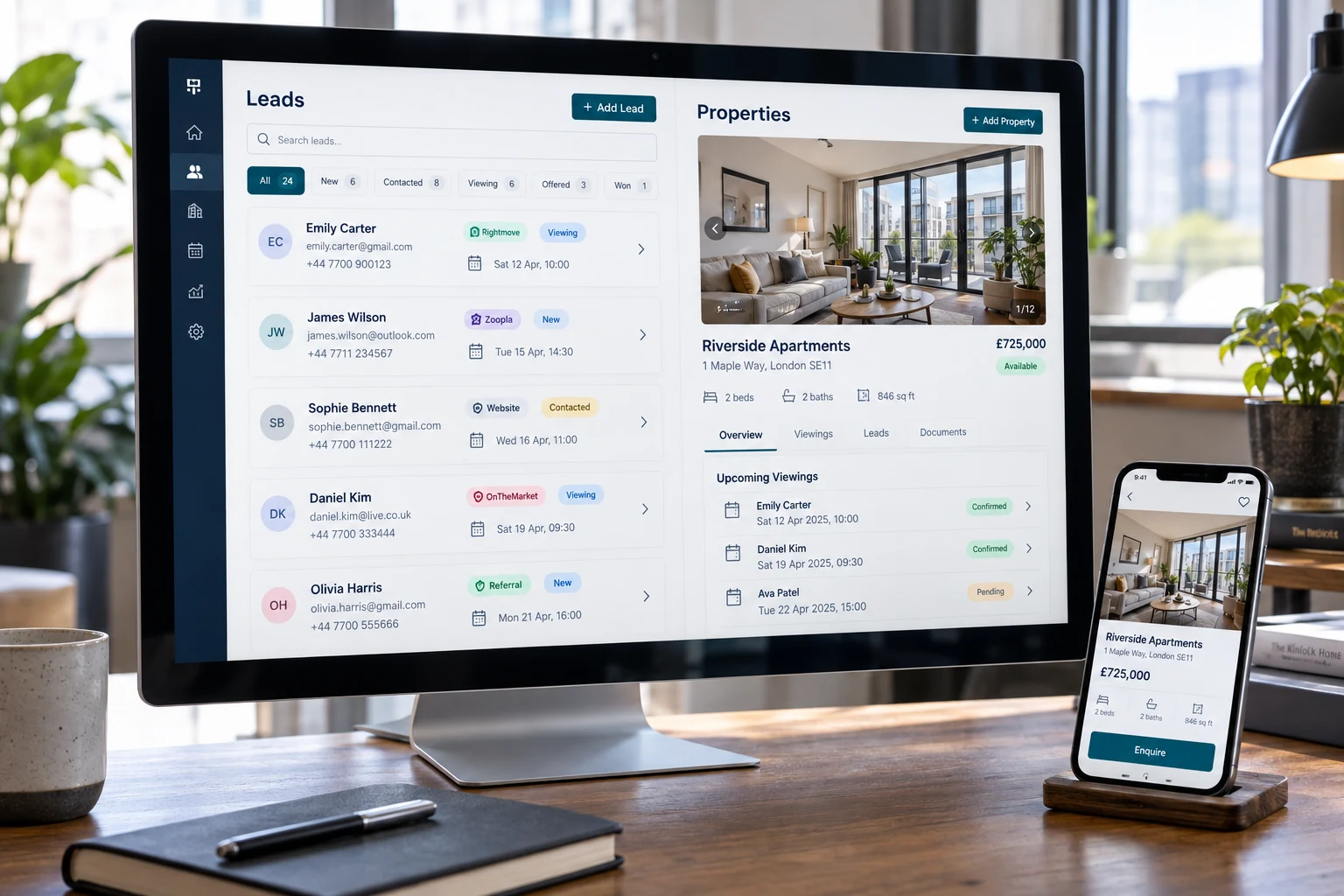
In modern real estate brokerages, automating real estate deals directly from listing metadata eliminates the operational friction between listing inventory and transaction closing, empowering agents to generate contract-ready deals in under 3 seconds with zero manual re-entry.
Automating Real Estate Deals from Listing Records
Property listings and financial deals represent two fundamentally different data lifecycle domains within a brokerage:
- The Listing Domain (Inventory & Syndication): Governed by MLS feeds, portal schemas (Bayut, Property Finder, Dubizzle), high-resolution media galleries, and government compliance permits (e.g., RERA or DLD verification).
- The Deal Domain (Transactional Execution): Governed by buyer/seller contracts, deposit milestones, legal escrows, multi-tier commission splits, and conveyance tracking.
When these two systems are decoupled, agents spend up to 25% of their working hours copying data across windows. The engineering solution is an Automated Deal Enrichment Engine that binds a listing reference ID directly to a CRM deal entity and hydrates all transactional fields in a single asynchronous execution.
Architecture of the Listing-to-Deal Synchronization Engine
An enterprise synchronization pipeline operates as a stateless event-driven service between the centralized property database and the CRM REST API:
1. Unified Property Reference Binding
Whether an agent initiates a deal from a web portal widget or inside the CRM interface, the trigger payload transmits two primary keys: property_id (the unique listing reference) and deal_id.
// Resolving property metadata and triggering field mapping
$ref = $_POST['property_id'] ?? '';
$dealId = $_POST['deal_id'] ?? '';

$property = $db->getPropertyByReference($ref);
if (!$property) {
    http_response_code(404);
    echo json_encode(['status' => 'error', 'message' => "Listing {$ref} not found"]);
    exit;
}

// Extract and normalize property classifications
$propertyType = $db->resolvePropertyType($property['property_type_id']);
$dealFields = buildDealPayload($property, $propertyType, $dealId);
$crm->updateDeal($dealId, $dealFields);
2. Hierarchical Entity Mapping (Smart Process Automation)
Real estate locations are rarely flat text fields. Enterprise CRMs structure geographic data into hierarchical custom entities: Community → Sub-Community → Building/Tower. The mapping microservice performs fuzzy and exact matches against the CRM's Smart Process Automation (SPA) entity indexes, resolving foreign IDs rather than storing fragile raw strings:
- Enumeration Matching: Normalizes property types (e.g., matching 'Townhouse' or 'Penthouse' to the CRM enum dictionary with fallback partial token matching).
- Financial Normalization: Casts rental frequencies (annual, quarterly, monthly) and sale prices into standardized numeric currencies for pipeline aggregation.
- Owner/Agent Association: Automatically cross-references listing broker IDs to link the correct internal listing agent to the deal record for automated attribution.
Tangible Business Benefits for Scaling Brokerages
Zero Duplicate Data Entry
Agents generate complete, contract-ready deals in under 3 seconds with a single click from the listing screen.
100% Contract Accuracy
Eliminates mismatched unit numbers, incorrect plot sizes, and mistaken title deed references on legal sales agreements.
Instant Pipeline Forecasting
Executive leadership gains real-time visibility into active pipeline volume sorted by accurate community and property type classifications.
Conclusion
Automating the hydration of deal pipelines from property inventory bridges the gap between marketing syndication and back-office settlement. Brokerages adopting this architecture accelerate transaction cycle times by up to 40% while freeing sales teams to focus purely on client negotiation.