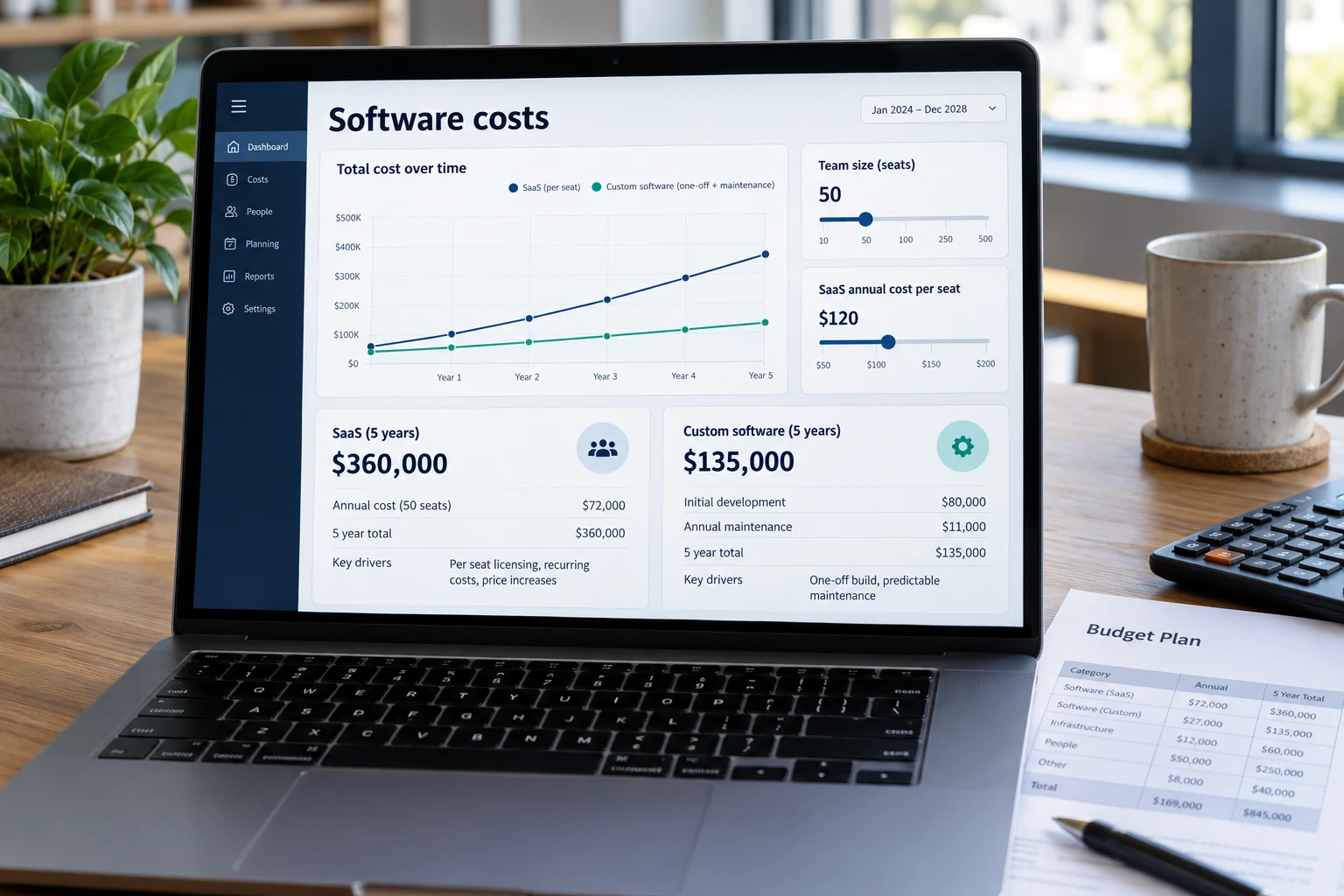
Every growing business begins with SaaS subscriptions for fast validation. However, when evaluating custom software vs saas for scaling enterprises, the total cost of ownership curve reverses dramatically as headcount and operational complexity expand.
Custom Software vs SaaS: The Hidden Per-Seat Tax
Consider an Australian services or logistics firm with 75 employees utilizing specialized workflow software. At an average SaaS tier of $160 AUD per user per month:
- Year 1: $144,000 AUD in licensing fees
- Year 3: $432,000 AUD (excluding typical 7–12% annual vendor price escalations)
- Year 5: Over $750,000 AUD spent with zero equity or intellectual property retained
The Four Hidden Costs of Generic Commercial Software
1. Workflow Compromise Overhead
When your software is built for millions of generic users, your staff must adapt their business processes to the tool rather than adapting the tool to their competitive advantage. The result is spreadsheet sprawl, manual copy-pasting between systems, and lost productivity.
2. Integration & Tier Lock-In Penalties
SaaS providers intentionally gate essential enterprise features—such as single sign-on (SSO), webhook triggers, audit logs, and API rate limits—behind their highest "Enterprise" tiers, multiplying license costs by 2x to 4x.
3. Data Hostage Risks & Vendor Deprecation
When a third-party vendor alters their pricing model, discontinues an API endpoint, or suffers an outage, your business operations stall. Migrating away from a deeply embedded SaaS platform with locked databases can take months of emergency re-engineering.
4. Balance Sheet Enterprise Value
"SaaS subscriptions are classified as pure operational expenditures (OpEx) that add zero valuation to your company. Bespoke software platforms, conversely, are capitalizable intellectual property (IP) assets that significantly increase your company's EBITDA multiple during investment rounds or acquisitions."
When Does Custom Software Make Financial Sense?
If your software directly touches your core revenue-generating mechanism, your team exceeds 30 active daily users, or generic platforms require more than two full-time employees just to bridge manual data gaps, custom engineering pays for itself within 12 to 18 months.