Enterprise executives understand the transformative power of generative AI, but engineering a production-grade enterprise llm integration requires an unyielding commitment to corporate data governance. Exposing sensitive financial audits, legal contracts, or customer identities to public models carries severe compliance risks.
Enterprise LLM Strategy: Private RAG vs Generic Models
Public conversational models are inherently stateless and prone to hallucinations when queried on internal business knowledge. Fine-tuning models on proprietary data is cost-prohibitive and frequently produces catastrophic forgetting.
The production standard for enterprise intelligence is Retrieval-Augmented Generation (RAG) deployed within a private Virtual Private Cloud (VPC) with zero data retention policies.
Key Pillars of a Production Enterprise RAG Pipeline
1. Semantic Document Chunking & Hybrid Search
Raw corporate documents (PDFs, DOCX, internal wikis, database records) cannot simply be dumped into an embedding model. Effective pipelines utilize semantic chunking:
- Context-Preserving Hierarchical Chunking: Preserving document parent headers and table structures during tokenization.
- Hybrid Search (Dense + Sparse): Combining vector similarity (e.g., cosine distance in Pinecone or Qdrant) with sparse keyword matching (BM25) to ensure precise acronym and part-number retrieval.
- Cross-Encoder Reranking: Passing top-k candidate chunks through a reranking model to filter irrelevant noise before prompt assembly.
2. Strict Zero Data Retention (ZDR) Enforcement
Under the Australian Privacy Principles (APPs) and international data protection standards, client and employee data must never be used to train foundational AI models. Enterprise deployments must enforce:
"Direct API endpoints configured with explicit zero-data-retention guarantees, private VPC peering, transit encryption via TLS 1.3, and AES-256 rest encryption on all vector database indexes."
3. Citation Grounding & Guardrails
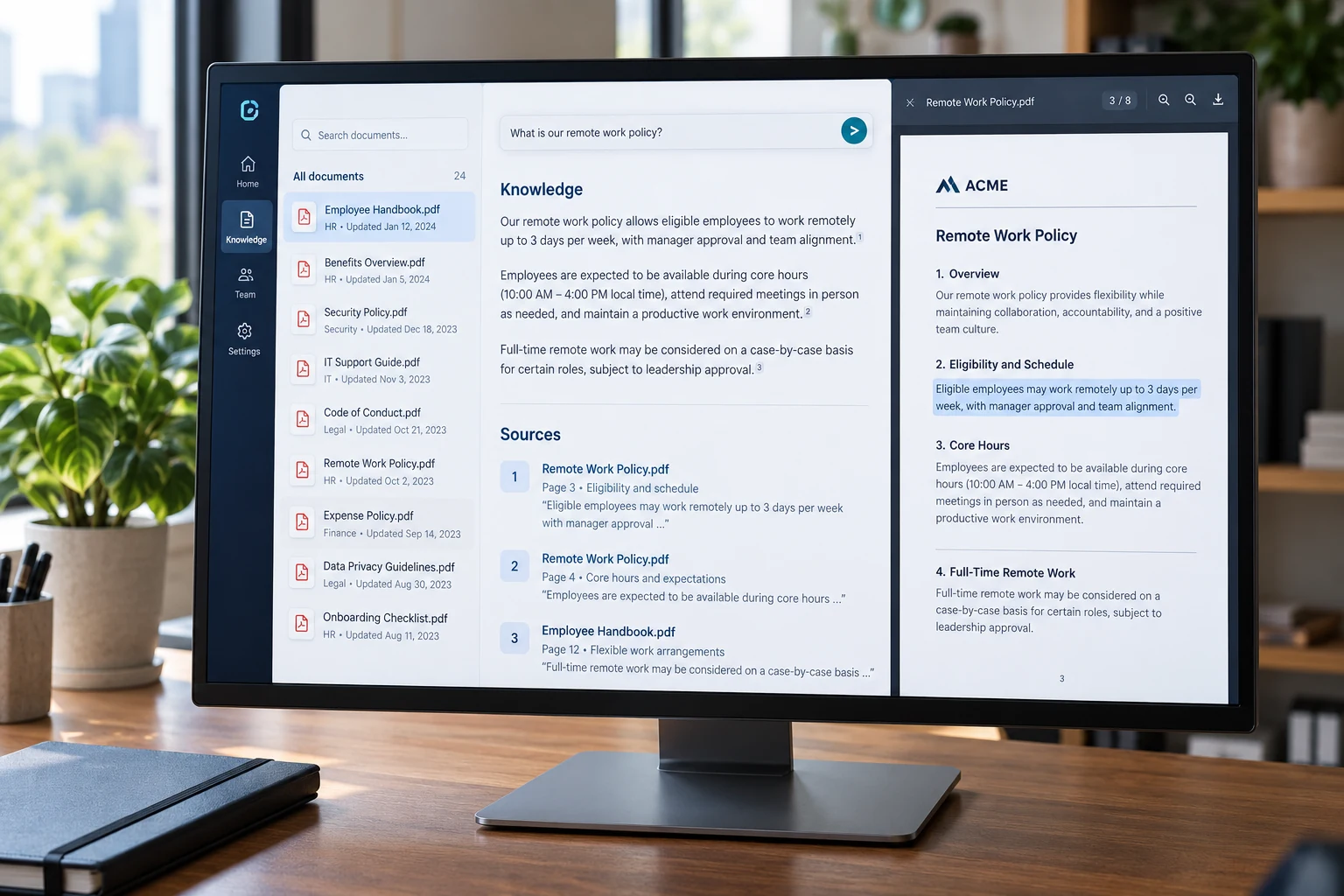
To eliminate hallucinations, the LLM is instructed with strict grounding constraints. Every statement generated in the output is accompanied by clickable citations linking directly to the source document page or database record. When source data does not contain the answer, the model explicitly declines to answer rather than speculating.
Measurable Business Impact
Enterprises implementing custom RAG pipelines typically observe an 80% reduction in manual document triage time, 24/7 internal knowledge retrieval for frontline support staff, and airtight compliance that passes SOC 2 and ISO 27001 audit controls.